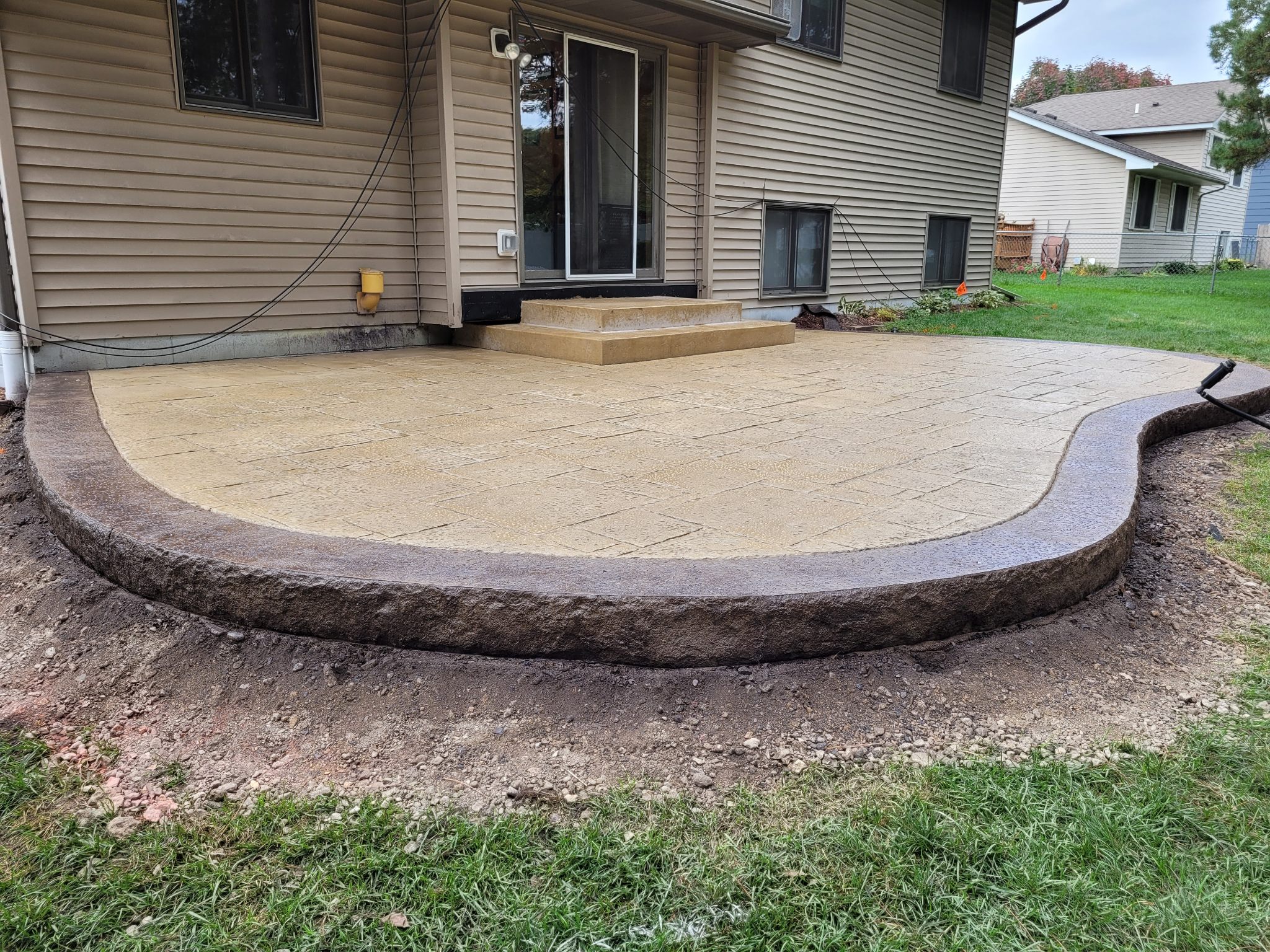
Most people land on this question after getting two very different quotes. One contractor wants to pour and stamp. Another wants to lay pavers. The pictures both look good, the prices are not close, and nobody has explained what you actually get for the difference.
Here is the straight comparison, including the places where pavers win.
Quick comparison
| Stamped concrete | Pavers | |
|---|---|---|
| Installed cost | Lower | Higher, usually the most expensive option |
| Install time | One to two days, plus curing before use | One to two days, usable right away |
| Look | Patterns and colors pressed into one continuous slab | Individual units with real joints |
| Repairs | Patches are visible, color matching is hard | Lift and replace individual pavers |
| Settling | Fixed by the base, cracks if the base fails | Re-level and reset as needed |
| Upkeep | Reseal every few years | Joint sand, weed and ant control, occasional resetting |
| Weeds | None, it is one surface | Grow in the joints |
| Lifespan | 25 to 30 years or more with a proper base | Similar or longer, with more hands-on upkeep |
Cost, in plain terms
Plain broom-finish concrete is almost always the cheapest way to cover square footage. Pavers are almost always the most expensive installed, because you are paying for the units themselves plus the labor to set each one. Stamped concrete sits in the middle, and on a simple layout it lands much closer to plain concrete than to pavers.
Where the gap narrows is on complicated work. An elaborate stamped pattern with multiple colors, borders and hand-detailing costs real money. A basic paver patio in a standard pattern is not exotic. On a small, fussy project the two can end up in the same neighborhood.
Anyone who quotes you a price per square foot without seeing the site is guessing. Access, tear-out of what is already there, grading, base depth and the shape of the space move the number more than the surface material does.
The Minnesota question: freeze and thaw
This is the part that matters here and gets glossed over everywhere else.
Twin Cities frost depth runs several feet down. Every winter the ground under your patio swells and settles. Both surfaces have to deal with it, they just deal with it differently.
Pavers flex. They are individual units sitting on compacted base and sand. When the ground moves, they move with it. When they move too much, you pull them up, fix the base and reset them. That flexibility is the single best argument for pavers in a cold climate, and it is a real one.
Concrete relies on the base and the joints. A slab does not flex, so everything depends on what is underneath it and where the control joints are cut. Done right, with properly compacted base, adequate thickness and joints in the correct places, a slab handles Minnesota winters for decades. Done wrong, it cracks, and a cracked slab is a much bigger problem than a settled paver.
That is the honest version. Concrete has a higher ceiling and a lower floor. The quality of the crew matters more with concrete than it does with pavers.
Repairs
Pavers win here, clearly.
If three pavers settle or a corner sinks, you lift that section, correct the base, and put the same units back. The repair disappears. If a tree root pushes a section up, same answer.
Concrete repairs are patches. A crack can be filled and a section can be replaced, but matching the color and the stamped texture of a slab that has been weathering for eight years is difficult, and the repair will usually be visible. On a stamped patio, a visible patch bothers people.
The counter is frequency. A properly built slab needs very few repairs. A paver installation needs small attention more often.
Upkeep
Stamped concrete needs resealing, typically every two to three years in this climate. Sealer is what keeps the color from fading and keeps moisture out of the surface. Skipping it is the most common reason stamped work looks tired at year ten.
Pavers need joint sand topped up, weeds pulled or treated, and the occasional ant hill dealt with. Polymeric sand helps a lot but does not eliminate it. Every few years a section may need resetting.
Neither is maintenance-free. Stamped concrete concentrates the work into one job every few years. Pavers spread smaller tasks across every season.
Winter and de-icing salt
Salt is hard on both. On concrete it causes surface scaling and spalling, especially on newer slabs. On pavers it degrades the surface of the units and can wash out joint sand.
Use sand for traction when you can. If you do use a de-icer, avoid it entirely the first winter on new concrete, and go light after that.
When we tell people to choose pavers
We pour concrete for a living, so take this for what it is worth, but there are projects where pavers are the better answer:
- The area has known drainage or settling problems you are not prepared to fix properly first
- You want to be able to change the layout later
- You want a true old-world look with visible joints, where stamped concrete would read as an imitation
- The space is small, oddly shaped, or has a lot of curves and obstacles
When stamped concrete is the better call
- You are covering real square footage and cost matters
- You want one continuous surface with no joints to weed
- The look you want is slate, wood plank, cobblestone pattern or something custom, which stamping does well
- You want less seasonal upkeep and are willing to reseal on a schedule
- You are pairing a patio and driveway and want them to match
The honest summary
Pavers buy you flexibility. Concrete buys you a continuous surface at a lower cost, and in exchange you depend much more on the crew doing the base and the joints correctly.
If you are getting quotes, ask every contractor the same three questions: how deep is the base, how is it being compacted, and where will the control joints go. The answers will tell you more about how the project turns out than the material choice will.
Creative Concrete has been pouring in the Twin Cities since 1998. We will tell you honestly if we think your project is better suited to something we do not install.
Looking at a project? See our work on concrete patios and concrete driveways, read up on stamped versus textured concrete, or request a free estimate.