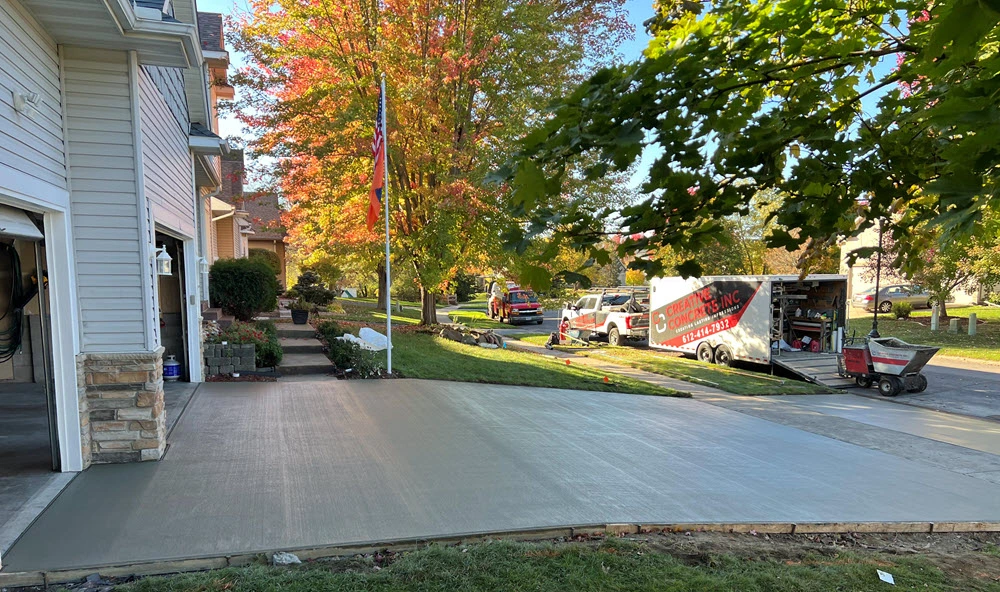
Reviewed by Bryan Stanley, Creative Concrete Inc.
four inches is the standard for a driveway that parks cars and light pickups. Five to six inches is what you want if an RV, a loaded trailer, or a work truck will sit on it or drive across it.
That is the part everybody asks. It is also the part that matters least, and this is the thing contractors do not always say out loud: a four inch slab on a properly prepared base will outlast a six inch slab poured on soft ground. In Minnesota, the base is the whole ballgame.
The numbers
| What the driveway carries | Slab thickness |
|---|---|
| Cars and light pickups | 4 inches |
| Work trucks, RVs, loaded trailers | 5 to 6 inches |
| The apron where it meets the street | Often 6 inches |
The apron catches the garbage truck, the delivery truck and the plow. It takes more abuse than the rest of the driveway and is worth the extra inch.
Going from four inches to five adds roughly 25% more concrete to the pour. On a typical two car driveway that is real money, so it is worth being honest about whether you need it. If nothing heavier than a half ton pickup will ever sit on it, you do not.
Why the base matters more than the inch
Concrete is strong in compression and weak in bending. A slab sitting on uniform, well compacted base is only ever being compressed. A slab with a soft spot underneath has to span that gap, which means bending, which means cracking. Adding an inch of concrete does not fix a soft spot. It just makes a slightly stronger bridge over it.
What good preparation looks like:
- Four to eight inches of compacted aggregate base, graded and compacted in lifts rather than dumped and leveled
- Any organic material, old fill or soft clay dug out rather than built over
- Positive drainage away from the house and off the slab
- Uniform support all the way across, with no abrupt changes from rock to soil
In the Twin Cities the ground under your driveway moves every single winter. Frost depth here runs several feet down, well below anything you would excavate for a driveway, so nobody is building below the frost line. You cannot stop the movement. What you can do is make the movement uniform, which is what a properly compacted base does, and give the slab planned places to crack, which is what control joints do.
Control joints and why the lines are there
Those straight lines cut across a driveway are deliberate. Concrete shrinks as it cures and will crack somewhere. Control joints decide where.
A reasonable rule is joint spacing in feet of roughly two and a half times the slab thickness in inches. On a four inch slab that puts joints every ten feet or so. Panels should be close to square rather than long and narrow, because a long thin panel cracks across its middle no matter how thick it is.
If a quote does not mention joint layout, ask about it. It costs nothing to cut and it is the difference between hairline cracks along a line nobody notices and a random crack down the middle.
Rebar, wire mesh, or neither
Reinforcement does not stop concrete from cracking. It holds the two sides of a crack together so the slab stays one piece and the edges do not lift apart.
- Four inch residential slabs are commonly poured with wire mesh, or with rebar on a grid
- Five to six inch slabs carrying heavier loads generally use rebar
- Either one only works if it sits in the middle of the slab rather than on the ground, which is what chairs are for
A slab with rebar lying on the dirt is a slab with no reinforcement and a line item on the invoice.
What this means in a Minnesota winter
Three things do most of the damage here, and none of them are solved by thickness.
Water under the slab. Water that collects under a driveway freezes, expands and lifts. Drainage and base preparation handle this.
De-icing salt on the surface. Chlorides cause the surface to scale and flake, and new concrete is the most vulnerable. Use sand for traction instead, skip salt entirely the first winter, and go easy after that.
The plow. A snowplow blade catching a raised edge or a lifted panel takes a chunk out of it. Even joints and a flat finish matter more than most people expect.
Questions worth asking any contractor
Ask all three. The answers tell you more about how your driveway turns out than the thickness number does.
- How deep is the base, and how is it being compacted?
- Where will the control joints go, and how big are the panels?
- What reinforcement, and how is it being held up off the ground?
A contractor who answers those three clearly has thought about your specific site. One who only wants to talk about inches and price has not.
What we see when we tear one out
Four inches is the thickness we pour most often, and it holds up fine when the base under it was done right. The driveways we get called out to replace are broken up pretty bad, and it is almost never because somebody poured three and a half inches instead of four. It is what was underneath. Soft spots, old fill that was never dug out, water with nowhere to go. The slab did not fail because it was thin. It failed because it had to carry ground that moved.
That is why we spend more time talking about the base than the thickness when we walk a site with somebody.
Planning a driveway in the Twin Cities
If you are comparing quotes, compare what is under the slab, not just the number of inches in it. Two bids at the same thickness and very different prices usually differ in base depth, excavation, joint work and reinforcement, and that is where the lifespan of the driveway actually comes from.
Creative Concrete has been pouring in the Twin Cities since 1998. We will walk the site with you, tell you what thickness your driveway actually needs, and explain what we are putting underneath it.
Looking at a project? See our work on concrete driveways and concrete patios, read how long concrete takes to cure, or request a free estimate.